Eating in California has its undeniable pleasures. Everywhere you look, food is growing, even in February. Right now the citrus fruits are in season, and the orange and lemon trees are a beautiful sight. It's warm here, so one isn't always in the mood for the rich winter fare we enjoyed in England, like steak and mushroom pie, or lamb stew with dumplings. Our diet is changing a bit, just because it has to: we eat more citrus fruits, avacadoes, and Mexican food, and we eat less yogurt, chocolate and cheese because those things just aren't as good here.
Still, I miss cooking and eating in England, and so I try my best to cook English food here. I know that comforts the kids - they need familiarity in their new home, and nothing brings the comfort of familiarity like food. They ask for sausages and mash, fish and chips, roast chicken, apple crumble, good chocolate desserts - all things that aren't really a part of the American diet.
Speaking of familiarity, I am so happy to be reunited with my cookbooks. I have been without them for 6 months, as they went into storage in July. Opening them up again and reading the recipes was like conversing with an old friend. And the recipes brought back so many memories - some very old, some more recent. Each cookbook was acquired at a different phase in my life, so each one is associated in my mind with a specific time and place, and with the events and challenges that I was facing at that time and in that place. Most of the time, food is made with the intent to respond to an event or a challenge, so when I read a recipe I used to cook, I remember not only when I cooked it, but also why I cooked it. I cooked a spinach and goat's cheese quiche for a family blessing in Lincolnshire, I baked bread in Cambridge when we were first married because I wanted to get good a making French bread, I cooked Delia's chocolate bread and butter pudding in Huntingdon, usually late at night, because my kids adored it.
Often what happens to me and cookbooks is that I get stuck into one and attempt to cook my way through it. I'm fascinated right now with the book, La Dolce Vita. Sweet Dreams and Chocolate Memories by Isabel Coe. I am especially happy that this book is out of storage. It's one of those cookbooks that is half memoir, half cookbook. Isabel Coe tells stories about both sides of her family - some from Italy, some from Switzerland - and gives chocolate recipes which have been in her family for generations. It's fascinating reading, and the recipes are remarkable for their simplicity and elegance.
One recipe I tried this week from the book is 'Cold-Weather Parsenstein', which is basically a truffle recipe. It was Valentine's Day on Friday, and I always make the kids some kind of Valentine treat. This year I decided to make them chocolates, rather than buy chocolates, so I turned to this recipe. I changed it a bit for my use, and it was a huge hit. Tim said they were the best truffles I had ever made.
Valentine's Day Chocolates - For Tim
100 mls heavy whipping cream
1/2 teaspoon vanilla extract
250 grams dark chocolate
15 grams butter
50 grams raspberries
To coat:
3 tbsp cocoa powder
3 tbsp powdered sugar
150 grams dark chocolate
Pour the whipping cream and the vanilla extract in a saucepan or microwavable jug. Bring to the boil. In the meantime, chop up the chocolate and butter into little chunks in a large bowl. Pour the hot cream over the chocolate and butter and stir until the chocolate is melted. Stir in the rapsberries - don't worry, they will fall apart and disintegrate. Put the mixture in the fridge to cool.
When it is set, mix the cocoa powder and powdered sugar together in a small bowl. Coat your hands with powdered sugar, and make truffle balls - or whatever shape you like - out of the chocolate mixture. Roll the chocolate shapes in the cocoa power mixture, and place on a cookie sheet lined with parchment paper. Freeze the truffles for a couple of hours, until hard.
Finally, melt the dark chocolate over a double boiler. Coat the truffles in the melted chocolate, and place back on the parchment paper. Store in the fridge until ready to eat. Makes about 15 truffles, depending on how big you make them.
Sunday, 16 February 2014

Sunday, 19 January 2014
Since I last posted in this blog, we have moved countries. No more cooking in England, I'm afraid, at least for the foreseeable future. And I fear something is true which I have suspected all along: I actually enjoy cooking more in England than I do in the States. Since we have moved back to the States, I find myself just a little bit less interested in food than I have been for the past 18 years. This is an alarming development - not one I am happy with at all - but I have to admit that for the past few months it feels as though I have lost my cooking 'mojo'.
So, the only thing to be done is to pick myself up and find inspiration for my cooking in this different environment. We are moving to Southern California later this week, where we plan to live for a very long time, so that's the environment which will inform my cooking going forward.
To encourage myself to get back into cooking and find the same kind of excitement and pleasure in it that I once did, I forced myself to do something just a little bit different today with our Sunday roast. I focused on the vegetables. Instead of boiling the brussel sprouts, I roasted them - a far superior way of cooking them, I think. With the carrot and swede, I added orange peel, and they were amazing. To the green beans, I added lemon peel, which improved them greatly as well.
I think that vegetables are often hard to get right. I was surprised at how giving them just a little bit more attention transformed the meal from a bit mundane to rather special: the brussels were gleaming, the carrots were bright, the green beans dark and sophisticated. It made me happy to eat them. And that's a good sign for the future.
Carrots and Swede with Orange
1 lb. carrots, peeled and thickly sliced
1/2 lb. swede, peeled and cut into 1/2 inch cubes
Zest of 1 orange
butter, to taste
Boil the carrots and swede until tender. Drain them, and add butter to taste. Zest the orange over the pan, and stir thoroughly so the carrots and swede are coated evenly with the zest.
So, the only thing to be done is to pick myself up and find inspiration for my cooking in this different environment. We are moving to Southern California later this week, where we plan to live for a very long time, so that's the environment which will inform my cooking going forward.
To encourage myself to get back into cooking and find the same kind of excitement and pleasure in it that I once did, I forced myself to do something just a little bit different today with our Sunday roast. I focused on the vegetables. Instead of boiling the brussel sprouts, I roasted them - a far superior way of cooking them, I think. With the carrot and swede, I added orange peel, and they were amazing. To the green beans, I added lemon peel, which improved them greatly as well.
I think that vegetables are often hard to get right. I was surprised at how giving them just a little bit more attention transformed the meal from a bit mundane to rather special: the brussels were gleaming, the carrots were bright, the green beans dark and sophisticated. It made me happy to eat them. And that's a good sign for the future.
Carrots and Swede with Orange
1 lb. carrots, peeled and thickly sliced
1/2 lb. swede, peeled and cut into 1/2 inch cubes
Zest of 1 orange
butter, to taste
Boil the carrots and swede until tender. Drain them, and add butter to taste. Zest the orange over the pan, and stir thoroughly so the carrots and swede are coated evenly with the zest.
Friday, 23 November 2012
Today is the day after Thanksgiving, and that's got to be one of the best days of the year. It's the official start of the Christmas season, I am surrounded by exciting Thanksgiving left-overs - turkey, cranberry sauce, pumpkin pie, dinner rolls, sweet potatoes, and I have some surprisingly positive memories of this year's Thanksgiving that will be sustaining me through whatever dark times befall me in the near future.
I think we need to be clear about the importance of Thanksgiving, and I am not talking here about the culinary importance. For me, it is the premier event in which food and family intersect so strongly with one another that it is hard to keep them separate and distinct. This is not to say that I have confused my children with a turkey. I mean, rather, that while Thanksgiving is most definitely about turkey and pumpkin pie and cranberry sauce, it is just as much about the company with whom you eat it, such that memories of food at Thanksgiving cannot be separated from the memories of the people eating it.
For instance, one year my younger sisters were both living in London and I was a newly wed in Cambridge, and of course they came up for Thanksgiving. We spent the whole day making all the foods we always made at home for Thanksgiving, one of which is a dish called Yams and Apples (a yam is a sweet potato in our neck of the woods). It is a very time consuming dish and I remember my sister in my tiny apartment laboring over this big vat of yams and apples. And now whenever I make that dish, I often think of her. But it wasn't just that. It was a powerful experience - bonding together as sisters in a foreign country by practicing our own family culinary rituals, which had the deepest of meanings for us as members of that family.
And what is that meaning? Well, on the surface, Thanksgiving is about celebrating the survival of the Pilgrims during the first year after they arrived in America in 1620. We remember that they came to America because they wanted religious freedom which they could not get in England, and we are grateful that they had the courage to follow their convictions and found our country on such noble principles. That was always a very important meaning in our family. Thanksgiving is also about being thankful in general for the things that you have and the circumstances that you enjoy. But I think there is something else going on here that makes the meaning even more robust. If the ritual of Thanksgiving is about getting together with loved ones for a specific meal with a specific purpose, the meaning of Thanksgiving is embedded just as much in the meaning of those relationships with loved ones as it is in the meal itself. In other words, the meaning of Thanksgiving is family, and, without trying in any way sound sappy, the meaning of family is love. That's why my sisters and I had to get together and make Thanksgiving dinner even when we were living in different parts of a foreign country. Practicing our family culinary ritual meant re-connecting with our family, who were so far away and who we loved so dearly.
So, with Thanksgiving now being on an equal footing with life, love and the meaning of universe, as I mother I feel it is my duty to pass on the full Thanksgiving experience, in the hopes that one day they, too will catch the vision and feel the love whenever they see a turkey or a pumpkin pie.
And that 'full' experience starts with helping out in the kitchen on Thanksgiving eve. I love the hustle and bustle in a kitchen the night before Thanksgiving or Christmas; I love it when the kids help out. Not only are they learning, but it provides us with a common experience - a foundation on which to build our relationship further. So, my three little girls helped me assemble the brine in which we would soak the turkey overnight:

And my twelve year old made the best pumpkin pie filling I've ever had:

Imogen's Best Ever Pumpkin Pie
16 ounces cooked pumpkin or butternut squash
3/4 cup sugar
1/2 tsp salt
1 tsp cinnamon
1 tsp ground ginger
1/8 tsp cloves
3 large eggs
12 ounces evaporated milk
Mix all ingredients together, making sure the eggs are well beaten. Pour into a waiting pastry shell (that has not been baked at all, and see below for recipe). Cook at 200C/400F for about 15 minutes, then turn down the oven to 180C/350F and cook for another 20-30 minutes. The pie is done with a skewer inserted in the middle comes out clean.

I put the teenager in charge of pastry:

But she didn't always work on the pastry. Our kitchen was filled with lots of mayhem on Thanksgiving Eve, and it wasn't because of the younger children:


Now, this year, I feared for the pastry of my pumpkin and apple pies, and not because the teenager was in charge. I have had too many bad experiences with pastry sticking to the pan, or it tasting like cardboard. So, I used a method that I learned from one of Hugh Fearnley-Whittingstall's books. Instead of rolling it out, we simply broke off bits of pastry and pressed them into the pie dish, like so:

Perfect Pastry
125 grams butter, cut into small pieces
250 grams flour
pinch salt
1 egg yolk
juice of 1/4-1/3 lemon
Rub together the butter and the flour (and salt) with your fingers, until they look like porridge oats. Mix the egg yok and lemon juice together in a small bowl, and add this mixture one tablespoon at a time until the pastry sticks together. You may need to add a tablespoon of water or so to the pastry. Break off bits of pastry and press them into a pie dish until you have covered the bottom and sides sufficiently.
My next challenge was the apple pie. I think it is actually quite hard to make a good apple pie, and I was mildly surprised to find that I had a pretty strong desire to get it right this year. I put my nine year old son in charge of getting the pastry in the pan, using the same recipe and method as we did with the pumpkin pie,

The filling was as follows:
Thanksgiving Apple Pie
800 grams Bramley apples, grated
450 grams Cox apples, cubed
145 grams white sugar
15 grams brown sugar
25 grams butter
25 grams flour
juice of 1/2 lemon
1 tsp cinnamon
1/2 tsp mixed spice
1/4 tsp cloves
freshly grated nutmeg
Put all the ingredients into a big pan over a medium heat. Stir the filling often to make sure it doesn't catch. Cook for a few minutes until the apple cubes have softened somewhat. Then pour the filling into the waiting pastry case:

For the topping, I decided to use a crumble topping:
130 grams flour
90 grams butter
2 tbsp brown sugar
2 tbsp white sugar
Rub together the flour and butter between your fingers until they look like porridge oats. Mix in the sugars. Sprinkle over the filling. Bake at 190C/375F for about 30-35 minutes, until golden brown and bubbling on top.

On Thanksgiving morning, I woke up with refreshingly little to do, but I did have to get the turkey ready. I didn't do much to it, since I had soaked it the night before, but it was beautiful when it came out of the brine:

I am paranoid about dry white turkey meat, so I take all necessary precautions to avoid that. One trick I learned from a Jamie Oliver program is to put butter directly onto the breast meat, under the skin - something my children like to freak out about when they witness me doing it:

I had more help in the kitchen on the final stretch before dinner, with the teenager actually coming into the kitchen and saying to me 'Do you need me to help you?' This was without prompting. When I recovered from going into shock, I felt the biggest sense of accomplishment - my child asked to be helpful! Funny how having children makes you appreciate the very simple things in life. Either that or it reduces your expectations for yourself and for them to something so low that any good thing that happens is a bonus. I put her to work making a topping for some broccoli in a cream cheese sauce, which was bread crumbs, butter and grated cheddar cheese:

You can imagine how good the topping tasted. She took a bite, enthused about how delicious it was, and I responded in agreement. And in that moment, there was a unity between us, a shared understanding, that is not often there as of late. Food can bridge the generation gap - temporarily, maybe, but in a way that matters. And that brings us back full circle to the meaning of Thanksgiving: it's about a common experience, about family unity, about love:

Even when your teenager does this at the table:

I think we need to be clear about the importance of Thanksgiving, and I am not talking here about the culinary importance. For me, it is the premier event in which food and family intersect so strongly with one another that it is hard to keep them separate and distinct. This is not to say that I have confused my children with a turkey. I mean, rather, that while Thanksgiving is most definitely about turkey and pumpkin pie and cranberry sauce, it is just as much about the company with whom you eat it, such that memories of food at Thanksgiving cannot be separated from the memories of the people eating it.
For instance, one year my younger sisters were both living in London and I was a newly wed in Cambridge, and of course they came up for Thanksgiving. We spent the whole day making all the foods we always made at home for Thanksgiving, one of which is a dish called Yams and Apples (a yam is a sweet potato in our neck of the woods). It is a very time consuming dish and I remember my sister in my tiny apartment laboring over this big vat of yams and apples. And now whenever I make that dish, I often think of her. But it wasn't just that. It was a powerful experience - bonding together as sisters in a foreign country by practicing our own family culinary rituals, which had the deepest of meanings for us as members of that family.
And what is that meaning? Well, on the surface, Thanksgiving is about celebrating the survival of the Pilgrims during the first year after they arrived in America in 1620. We remember that they came to America because they wanted religious freedom which they could not get in England, and we are grateful that they had the courage to follow their convictions and found our country on such noble principles. That was always a very important meaning in our family. Thanksgiving is also about being thankful in general for the things that you have and the circumstances that you enjoy. But I think there is something else going on here that makes the meaning even more robust. If the ritual of Thanksgiving is about getting together with loved ones for a specific meal with a specific purpose, the meaning of Thanksgiving is embedded just as much in the meaning of those relationships with loved ones as it is in the meal itself. In other words, the meaning of Thanksgiving is family, and, without trying in any way sound sappy, the meaning of family is love. That's why my sisters and I had to get together and make Thanksgiving dinner even when we were living in different parts of a foreign country. Practicing our family culinary ritual meant re-connecting with our family, who were so far away and who we loved so dearly.
So, with Thanksgiving now being on an equal footing with life, love and the meaning of universe, as I mother I feel it is my duty to pass on the full Thanksgiving experience, in the hopes that one day they, too will catch the vision and feel the love whenever they see a turkey or a pumpkin pie.
And that 'full' experience starts with helping out in the kitchen on Thanksgiving eve. I love the hustle and bustle in a kitchen the night before Thanksgiving or Christmas; I love it when the kids help out. Not only are they learning, but it provides us with a common experience - a foundation on which to build our relationship further. So, my three little girls helped me assemble the brine in which we would soak the turkey overnight:

And my twelve year old made the best pumpkin pie filling I've ever had:

Imogen's Best Ever Pumpkin Pie
16 ounces cooked pumpkin or butternut squash
3/4 cup sugar
1/2 tsp salt
1 tsp cinnamon
1 tsp ground ginger
1/8 tsp cloves
3 large eggs
12 ounces evaporated milk
Mix all ingredients together, making sure the eggs are well beaten. Pour into a waiting pastry shell (that has not been baked at all, and see below for recipe). Cook at 200C/400F for about 15 minutes, then turn down the oven to 180C/350F and cook for another 20-30 minutes. The pie is done with a skewer inserted in the middle comes out clean.

I put the teenager in charge of pastry:

But she didn't always work on the pastry. Our kitchen was filled with lots of mayhem on Thanksgiving Eve, and it wasn't because of the younger children:


Now, this year, I feared for the pastry of my pumpkin and apple pies, and not because the teenager was in charge. I have had too many bad experiences with pastry sticking to the pan, or it tasting like cardboard. So, I used a method that I learned from one of Hugh Fearnley-Whittingstall's books. Instead of rolling it out, we simply broke off bits of pastry and pressed them into the pie dish, like so:

Perfect Pastry
125 grams butter, cut into small pieces
250 grams flour
pinch salt
1 egg yolk
juice of 1/4-1/3 lemon
Rub together the butter and the flour (and salt) with your fingers, until they look like porridge oats. Mix the egg yok and lemon juice together in a small bowl, and add this mixture one tablespoon at a time until the pastry sticks together. You may need to add a tablespoon of water or so to the pastry. Break off bits of pastry and press them into a pie dish until you have covered the bottom and sides sufficiently.
My next challenge was the apple pie. I think it is actually quite hard to make a good apple pie, and I was mildly surprised to find that I had a pretty strong desire to get it right this year. I put my nine year old son in charge of getting the pastry in the pan, using the same recipe and method as we did with the pumpkin pie,

The filling was as follows:
Thanksgiving Apple Pie
800 grams Bramley apples, grated
450 grams Cox apples, cubed
145 grams white sugar
15 grams brown sugar
25 grams butter
25 grams flour
juice of 1/2 lemon
1 tsp cinnamon
1/2 tsp mixed spice
1/4 tsp cloves
freshly grated nutmeg
Put all the ingredients into a big pan over a medium heat. Stir the filling often to make sure it doesn't catch. Cook for a few minutes until the apple cubes have softened somewhat. Then pour the filling into the waiting pastry case:

For the topping, I decided to use a crumble topping:
130 grams flour
90 grams butter
2 tbsp brown sugar
2 tbsp white sugar
Rub together the flour and butter between your fingers until they look like porridge oats. Mix in the sugars. Sprinkle over the filling. Bake at 190C/375F for about 30-35 minutes, until golden brown and bubbling on top.

On Thanksgiving morning, I woke up with refreshingly little to do, but I did have to get the turkey ready. I didn't do much to it, since I had soaked it the night before, but it was beautiful when it came out of the brine:

I am paranoid about dry white turkey meat, so I take all necessary precautions to avoid that. One trick I learned from a Jamie Oliver program is to put butter directly onto the breast meat, under the skin - something my children like to freak out about when they witness me doing it:

I had more help in the kitchen on the final stretch before dinner, with the teenager actually coming into the kitchen and saying to me 'Do you need me to help you?' This was without prompting. When I recovered from going into shock, I felt the biggest sense of accomplishment - my child asked to be helpful! Funny how having children makes you appreciate the very simple things in life. Either that or it reduces your expectations for yourself and for them to something so low that any good thing that happens is a bonus. I put her to work making a topping for some broccoli in a cream cheese sauce, which was bread crumbs, butter and grated cheddar cheese:

You can imagine how good the topping tasted. She took a bite, enthused about how delicious it was, and I responded in agreement. And in that moment, there was a unity between us, a shared understanding, that is not often there as of late. Food can bridge the generation gap - temporarily, maybe, but in a way that matters. And that brings us back full circle to the meaning of Thanksgiving: it's about a common experience, about family unity, about love:

Even when your teenager does this at the table:

Friday, 16 November 2012
It's autumn, I've got a pumpkin, and I'm not afraid to cook with it.

I'm really, really not. Whether or not my children are afraid - or loathe - to eat it, is a different matter. Since the beginning of October they have been subjected to all manner of pumpkin dishes, including pumpkin soup, pumpkin cheesecake, pumpkin crumble, pumpkin cupcakes, stew cooked in a pumpkin, pumpkin bread, beef stew with pumpkin, pumpkin lasagne, pumpkin cake roll and pumpkin trifle.
They found the stew cooked in a pumpkin amusing and fairly edible, they tolerated the pumpkin lasagne (the teenager actually asked for seconds!), avoided the pumpkin cheesecake and crumble, gaged on the pumpkin soup, and broke down and wept when presented with the pumpkin trifle. 'Aren't you through with pumpkins yet?' my nine year old son cried.
I shall, however, soldier on in the causes which I know to be worthwhile, even if I am surrounded by nay-sayers. Thanksgiving is coming up, and the pumpkin obviously cannot be abandoned until after that day. I would argue there is even a place for pumpkin at Christmastime. I saw a recipe for pumpkin jam which I think might taste good on a gingerbread muffin in the days leading to Christmas ...
One pumpkin recipe which my children don't hate and which I particularly enjoy making - therefore we are both happy, you see - is pumpkin bread. Not bread in the sense of banana bread or zucchini bread, but yeast bread. I found this recipe a few years ago on the King Arthur Flour website (www.kingarthurflour.com), and they have very kindly given me permission to reprint it here. This recipe always works - it makes the most soft, supple, elastic dough which you could possibly imagine, and the taste is very moorish.
King Arthur Flour Pumpkin Yeast Bread
1/2 cup warm water
2 tbsp active dry yeast
2/3 cup warm milk
2 large eggs, beaten
1 and 1/2 cups pureed pumpkin, either fresh or canned
2 tbsp vegetable oil
6 and 1/2 cups (approximately) King Arthur Unbleached All-Purpose Flour
1/2 cup brown sugar
2 tsp salt
1/2 tsp ground ginger
1/8 tsp ground cloves
1/4 tsp freshly ground nutmeg
In a large bowl, stir yeast into water to soften. Add milk, eggs, pumpkin, oil, 4 cups flour, brown sugar, salt, and spices. Beat vigorously for 2 minutes. The dough will look something like this:

Gradually add remaining flour, a little at a time, until you have a dough stiff enough to knead. Turn dough out onto a floured surface. Knead, adding flour as necessary, until you have a smooth, elastic dough.
Heat the oven to 190C/375F. Put the dough into a large, clean, lightly oiled bowl. Let rise at room temperature until doubled in size, about 2 hours. Gently punch down and slide it onto a floured surface. Shape either into loaves or rolls, and leave to rise for another 30 minutes or so. Bake the loaves for about 30 minutes, until they are brown on top and sound hollow when tapped at the bottom. The rolls will need less time, about 15 minutes, but keep an eye on them to make sure they don't brown too quickly.
I would be remiss if I didn't comment on what I think are very important flavors for the pumpkin. Obviously the cinnamon/nutmeg/clove/ginger combination is essential for many, if not most pumpkin recipes. For savoury dishes, however, garlic, chilli, and goats cheese take pumpkin to a different level - an edible level, my husband might argue (I don't get much support, do I?). And a match made in heaven is the pairing of pumpkin with amaretti biscuits:

This is the combination which I used in my pumpkin trifle. It may have been the cause of tears for my children, but frankly, they really don't know why they are crying, and neither do I. In this trifle I bake the pumpkin layer with amaretti biscuits, which results in something like the crust of a creme brulee. I then add the custard and cream layers on top, which softens the crust but seems to enhance it's burnt-sugar taste.
Holly's Pumpkin Trifle
for the pumpkin layer:
3/4 cup sugar
1/2 tsp salt
1 tsp cinnamon
1 tsp ground ginger
1/2 tsp cloves
freshly grated nutmeg
3 large eggs
400 grams cooked pumpkin (or butternut squash, of course)
400 mls evaporated milk
about 20 amaretti biscuits
for the custard layer:
350 mls milk
350 mls double cream
75 grams sugar
8 egg yolks
2 gelatine leaves
1 tsp vanilla extract
for the cream layer:
400 mls double cream
a few crushed amaretti biscuits
toasted, sliced almonds
Heat the oven to 190C/375F. For the pumpkin layer, put all the ingredients except the biscuits in a bowl and mix well. Grease a large, round baking or cassarole dish and arrange the amaretti biscuits on the bottom. Pour over the pumpkin mixture, and bake for about 30 minutes, until a skewer comes out clean.
Let it cool completely, and chill it for a few hours, or overnight, in the fridge.
To make the custard, first put the gelatine leaves to soak in a bowl of cold water (they need to soak for five minutes, or follow the directions on your packet). Combine the cream and milk and vanilla in a large saucepan. Heat it until the mixture is about to boil, then take off the heat. Whisk the egg yolks and sugar in a large bowl until frothy. Slowly pour the milk mixture into the egg mixture, whisking all the while. As soon as the milk and eggs have been combined, pour the whole thing back into the saucepan and whisk continually over a low heat until the custard starts to thicken. Take it off the heat, and continue to whisk for a minute or so. Squeeze out the gelatine leaves, and then whisk them into the custard. Whisk until the custard has cooled down a bit more, and then pour it over the pumpkin layer. Chill for at least four hours, or overnight.
For the cream layer, simply whip up the double cream and carefully spread it over the custard. Just before you serve, sprinkle it with the crushed biscuits and almonds.

I'm really, really not. Whether or not my children are afraid - or loathe - to eat it, is a different matter. Since the beginning of October they have been subjected to all manner of pumpkin dishes, including pumpkin soup, pumpkin cheesecake, pumpkin crumble, pumpkin cupcakes, stew cooked in a pumpkin, pumpkin bread, beef stew with pumpkin, pumpkin lasagne, pumpkin cake roll and pumpkin trifle.
They found the stew cooked in a pumpkin amusing and fairly edible, they tolerated the pumpkin lasagne (the teenager actually asked for seconds!), avoided the pumpkin cheesecake and crumble, gaged on the pumpkin soup, and broke down and wept when presented with the pumpkin trifle. 'Aren't you through with pumpkins yet?' my nine year old son cried.
I shall, however, soldier on in the causes which I know to be worthwhile, even if I am surrounded by nay-sayers. Thanksgiving is coming up, and the pumpkin obviously cannot be abandoned until after that day. I would argue there is even a place for pumpkin at Christmastime. I saw a recipe for pumpkin jam which I think might taste good on a gingerbread muffin in the days leading to Christmas ...
One pumpkin recipe which my children don't hate and which I particularly enjoy making - therefore we are both happy, you see - is pumpkin bread. Not bread in the sense of banana bread or zucchini bread, but yeast bread. I found this recipe a few years ago on the King Arthur Flour website (www.kingarthurflour.com), and they have very kindly given me permission to reprint it here. This recipe always works - it makes the most soft, supple, elastic dough which you could possibly imagine, and the taste is very moorish.
King Arthur Flour Pumpkin Yeast Bread
1/2 cup warm water
2 tbsp active dry yeast
2/3 cup warm milk
2 large eggs, beaten
1 and 1/2 cups pureed pumpkin, either fresh or canned
2 tbsp vegetable oil
6 and 1/2 cups (approximately) King Arthur Unbleached All-Purpose Flour
1/2 cup brown sugar
2 tsp salt
1/2 tsp ground ginger
1/8 tsp ground cloves
1/4 tsp freshly ground nutmeg
In a large bowl, stir yeast into water to soften. Add milk, eggs, pumpkin, oil, 4 cups flour, brown sugar, salt, and spices. Beat vigorously for 2 minutes. The dough will look something like this:
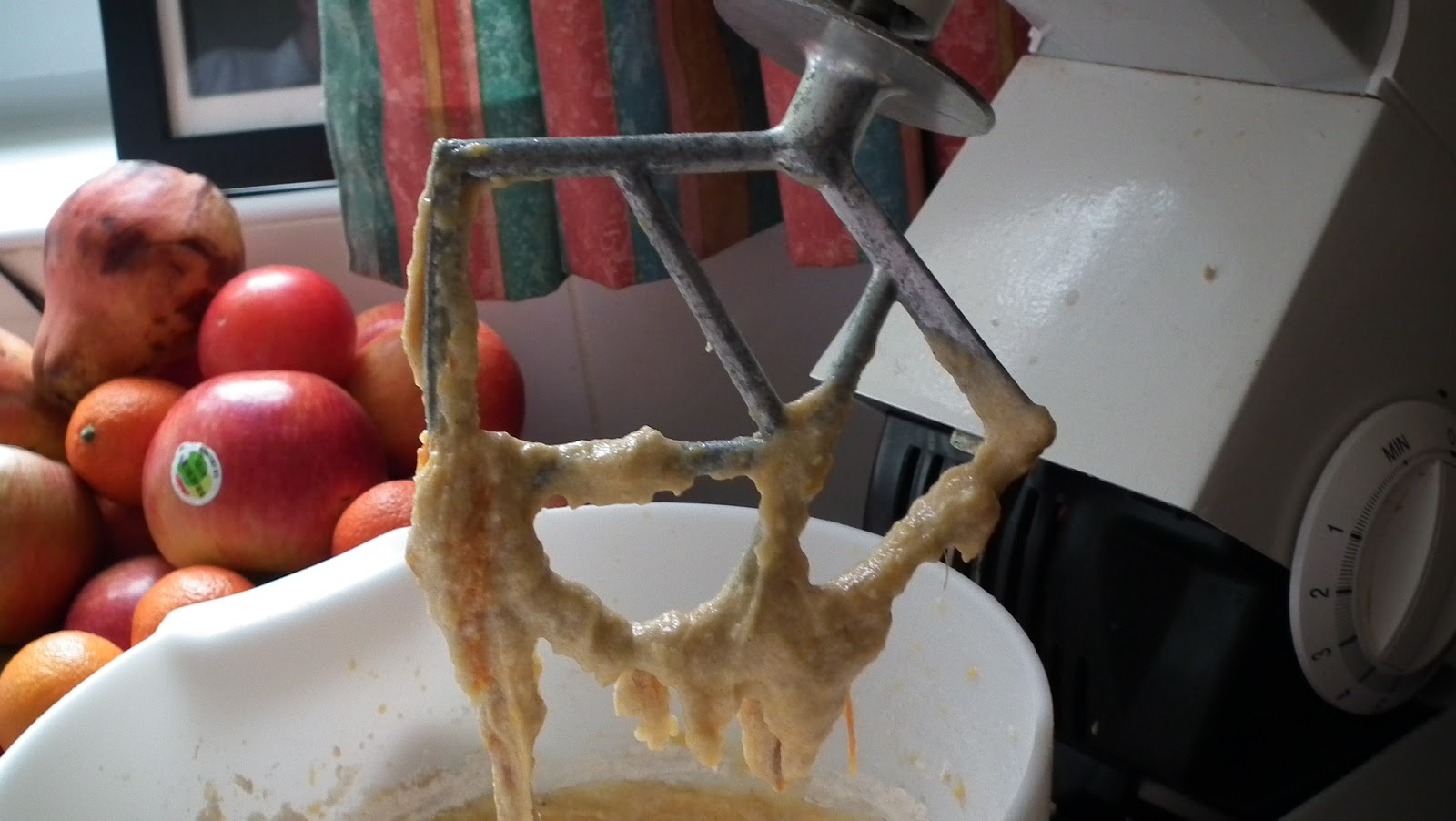
Gradually add remaining flour, a little at a time, until you have a dough stiff enough to knead. Turn dough out onto a floured surface. Knead, adding flour as necessary, until you have a smooth, elastic dough.
Heat the oven to 190C/375F. Put the dough into a large, clean, lightly oiled bowl. Let rise at room temperature until doubled in size, about 2 hours. Gently punch down and slide it onto a floured surface. Shape either into loaves or rolls, and leave to rise for another 30 minutes or so. Bake the loaves for about 30 minutes, until they are brown on top and sound hollow when tapped at the bottom. The rolls will need less time, about 15 minutes, but keep an eye on them to make sure they don't brown too quickly.
I would be remiss if I didn't comment on what I think are very important flavors for the pumpkin. Obviously the cinnamon/nutmeg/clove/ginger combination is essential for many, if not most pumpkin recipes. For savoury dishes, however, garlic, chilli, and goats cheese take pumpkin to a different level - an edible level, my husband might argue (I don't get much support, do I?). And a match made in heaven is the pairing of pumpkin with amaretti biscuits:

This is the combination which I used in my pumpkin trifle. It may have been the cause of tears for my children, but frankly, they really don't know why they are crying, and neither do I. In this trifle I bake the pumpkin layer with amaretti biscuits, which results in something like the crust of a creme brulee. I then add the custard and cream layers on top, which softens the crust but seems to enhance it's burnt-sugar taste.
Holly's Pumpkin Trifle
for the pumpkin layer:
3/4 cup sugar
1/2 tsp salt
1 tsp cinnamon
1 tsp ground ginger
1/2 tsp cloves
freshly grated nutmeg
3 large eggs
400 grams cooked pumpkin (or butternut squash, of course)
400 mls evaporated milk
about 20 amaretti biscuits
for the custard layer:
350 mls milk
350 mls double cream
75 grams sugar
8 egg yolks
2 gelatine leaves
1 tsp vanilla extract
for the cream layer:
400 mls double cream
a few crushed amaretti biscuits
toasted, sliced almonds
Heat the oven to 190C/375F. For the pumpkin layer, put all the ingredients except the biscuits in a bowl and mix well. Grease a large, round baking or cassarole dish and arrange the amaretti biscuits on the bottom. Pour over the pumpkin mixture, and bake for about 30 minutes, until a skewer comes out clean.
Let it cool completely, and chill it for a few hours, or overnight, in the fridge.
To make the custard, first put the gelatine leaves to soak in a bowl of cold water (they need to soak for five minutes, or follow the directions on your packet). Combine the cream and milk and vanilla in a large saucepan. Heat it until the mixture is about to boil, then take off the heat. Whisk the egg yolks and sugar in a large bowl until frothy. Slowly pour the milk mixture into the egg mixture, whisking all the while. As soon as the milk and eggs have been combined, pour the whole thing back into the saucepan and whisk continually over a low heat until the custard starts to thicken. Take it off the heat, and continue to whisk for a minute or so. Squeeze out the gelatine leaves, and then whisk them into the custard. Whisk until the custard has cooled down a bit more, and then pour it over the pumpkin layer. Chill for at least four hours, or overnight.
For the cream layer, simply whip up the double cream and carefully spread it over the custard. Just before you serve, sprinkle it with the crushed biscuits and almonds.
Tuesday, 6 November 2012
As I write, we are deep into autumn, which has always been my favorite time of year. I love it when the days get shorter and the weather turns colder - time for warm boots and chunky sweaters. It is time also, of course, for certain kinds of foods, like rich stews, mulled drinks, and, dare I say it - sugar, in all it's wonderful forms.
Yes, it was Halloween this past week, and we enjoyed (survived?) a sugar-filled day, even before the trick-or-treating started. We made Halloween sugar cookies:

Our mission was to decorate them with all manner of candy:

And someone was so excited that she couldn't wait for the cookies to come out of the oven:

She was able to engage finally in a shameful sugar fest that included not only burying sugar cookies under a mountain of frosting and sprinkles, but also transforming pumpkin cupcakes into edible (inedible?), giant spiders as well:


The simple sugars of Halloween baking are fun, charming, and I would even be willing to argue, in certain cases, necessary. They are not, however, what I associate most with autumn. For that, we have to look further afield, to the less refined sugars of treacle, brown sugar, and golden syrup. Butter + any one of these sugar products makes for a carmel-ly taste, which has to win first place as the taste of autumn. Put any of these sugars with butter, ginger or allspice in a baked item, and you have the perfect treat for a cold autumn day.
We went hill walking last week. It was a little strenuous (I mean, come on, this is Britain, so the hills aren't going to be that high, are they?), and very cold. Can you tell?

And the perfect pick-me-up during the walk was a dark, sticky gingerbread, which was remarkable for it's warming properties (was it the calories, do you think?):

The ultimate crowd pleaser, however - the heartwarming, golden syrup-infested, comforting, this-will-lift-you-out-of-a-clinical-depression, post-hill walking treat was my flapjacks. Need I say more?
Hill Walking Flapjacks
225 grams butter
110 grams demerara sugar
6 tbsp golden syrup
375 grams porridge oats
dash salt
dash ginger
Grease a 10 x 8 inch square pan, and line it with greaseproof paper. Slowly melt the butter, sugar, golden syrup, salt and ginger together in a large saucepan.

When the sugar and the butter are melted, pour in the oats. Stir to coat thoroughly, then pour into the prepared pan. Bake at 180C/350F for about 15-20 minutes, until they are golden brown around the edges.
Yes, it was Halloween this past week, and we enjoyed (survived?) a sugar-filled day, even before the trick-or-treating started. We made Halloween sugar cookies:

Our mission was to decorate them with all manner of candy:

And someone was so excited that she couldn't wait for the cookies to come out of the oven:

She was able to engage finally in a shameful sugar fest that included not only burying sugar cookies under a mountain of frosting and sprinkles, but also transforming pumpkin cupcakes into edible (inedible?), giant spiders as well:


The simple sugars of Halloween baking are fun, charming, and I would even be willing to argue, in certain cases, necessary. They are not, however, what I associate most with autumn. For that, we have to look further afield, to the less refined sugars of treacle, brown sugar, and golden syrup. Butter + any one of these sugar products makes for a carmel-ly taste, which has to win first place as the taste of autumn. Put any of these sugars with butter, ginger or allspice in a baked item, and you have the perfect treat for a cold autumn day.
We went hill walking last week. It was a little strenuous (I mean, come on, this is Britain, so the hills aren't going to be that high, are they?), and very cold. Can you tell?

And the perfect pick-me-up during the walk was a dark, sticky gingerbread, which was remarkable for it's warming properties (was it the calories, do you think?):

The ultimate crowd pleaser, however - the heartwarming, golden syrup-infested, comforting, this-will-lift-you-out-of-a-clinical-depression, post-hill walking treat was my flapjacks. Need I say more?
Hill Walking Flapjacks
225 grams butter
110 grams demerara sugar
6 tbsp golden syrup
375 grams porridge oats
dash salt
dash ginger
Grease a 10 x 8 inch square pan, and line it with greaseproof paper. Slowly melt the butter, sugar, golden syrup, salt and ginger together in a large saucepan.

When the sugar and the butter are melted, pour in the oats. Stir to coat thoroughly, then pour into the prepared pan. Bake at 180C/350F for about 15-20 minutes, until they are golden brown around the edges.
Thursday, 18 October 2012
A few weeks ago our family was deemed a charity case by someone who works in the food industry. This person has now developed what seems to be a habit of giving us a box, or two, every week full of fruits and vegetables which are about to go bad within the next twelve hours. Although in my head I know I should be very grateful for free food, my gut reaction is to feel a little bit annoyed that someone is giving me food with which I have to do something almost right as I am receiving it. I am inflexible by nature and frankly, these donations screw up my all-important SCHEDULE.
However, in the spirit of 'enjoy the journey' and 'make time for surprises' and other mantras by which I feel obliged to at least attempt to live, I have rather grudgingly drug myself into the kitchen and thought about what I could do to not waste this food. Happily, I made some joyous culinary discoveries which I would not have made had the opportunity not been thrust upon me, the most notable one being my original Figgy Chutney.
Yes, I was given many figs. I couldn't roast them all with butter and honey, so chutney seemed like a good option. I kept singing the song 'Oh, bring us some figgy pudding ...', and although I knew that figgy pudding is made with dried figs, the idea took hold of me and I found myself wanting to replicate the figgy pudding experience, but with fresh figs and in a chutney. Luckily, I had some damsons lying around for which I had no plans, and I thought they could serve as the plum element that is present in the pudding. I used currants, an apple, Christmas spices, and even vanilla. The result was, well, a delicious, Christmas-y, figgy chutney. I cannot wait to put it on the cheeseboard at Christmas.
Figgy Chutney
250 grams onion, chopped
100 grams apple, chopped
210 grams currants
40 grams raisins
700 grams figs, cut into quarters
250 grams damsons or plums (if using plums, stone and quarter them)
300 grams light brown sugar
250 mls cider vinegar
100 mls red wine vinegar
3 balls stem ginger
Juice of 1/2 lemon
Juice of 1 orange
1/4 teaspoon coriander
1/4 teaspoon cloves
2 and 1/2 teaspoon ginger
1 and 1/2 teaspoon cinnamon
1/4 teaspoon cayenne pepper
Freshly grated nutmeg (about 1/8 teaspoon)
1 teaspoon vanilla
Put all the ingredients to a big pot. The red-ish figs contrast beautifully against the dark damsons in this raw state.

Slowly bring the ingredients to the boil, stirring frequently. Simmer for a few hours until the right consistency is reached, and then pack them into sterilized jars. If you are using damsons instead of plums, you will need to fish the stones out after about an hour of cooking. As the figs and damsons simmer the chutney will cohere and become a gorgeous Christmas-y burgandy color.

I also tried making fig conserve, which was incredible! That same reddish burgandy color came out as I watched the conserve cook. I served it to my husband for an autumn breakfast in bed one weekend:

While we're on the subject of conserves, I have to say that we, the charity case people, were also given two massive marrows. I know that marrow is pig food in Italy and France, but, again, part of me wanted to be thrifty and make use of this rather unusable vegetable. I had seen recipes for marrow and ginger jam, so I thought I would try to do that. I wondered who would eat it, though, and then remembered that we were having a Harvest Festival celebration at our church on Sunday, and that we were going to all bring food for the homeless to church that day. What could be more in keeping with the festival than to bring food from the harvest, made into a preserve, to share with the homeless?
So, I set to work on my marrow jam. My husband was in the kitchen at the time, so I shared my charitable plans with him
'Who do you think is going to eat this jam?' he said.
'Well, I thought I would bring it to church on Sunday to give to the homeless.' I answered.
'What?!! The homeless aren't going to eat that!'
'So, are you saying that this jam isn't even good enough to give to people who are starving?'
My husband did some very quick thinking. 'No, I'm saying that it's going to be too good. They won't appreciate it. They won't even know what it is.'
'But on the BBC website it said that this is a traditional jam,' I protested.
'Look, I'm just saying that they aren't going to want to eat something that isn't familiar to them,' he warned.
Well, we are all entitled to our own opinions. I have finished the jam this morning, and I have to say it's pretty rockin'. As a charity case myself, I would be only too happy if someone gave it to me.
Marrow and Ginger Jam
1 kilo marrow, peeled and cubed (this is the weight it should be after you have peeled and cubed it)
1 kilo jam sugar
Juice and zest of 2 lemons
4 balls of preserved ginger (about 80 grams), shredded
1/4 teaspoon cloves
1/8 teaspoon freshly grated nutmeg
Place the marrow and the lemon juice in a big jam pot. Cook very gently until the marrow is translucent. Stir in the zest, ginger, sugar and spices. Let the sugar dissolve, and then turn up the heat so that the mixture comes to a rolling boil. Boil for four minutes, or until setting point is reached. Pack into sterilized jars and seal.
However, in the spirit of 'enjoy the journey' and 'make time for surprises' and other mantras by which I feel obliged to at least attempt to live, I have rather grudgingly drug myself into the kitchen and thought about what I could do to not waste this food. Happily, I made some joyous culinary discoveries which I would not have made had the opportunity not been thrust upon me, the most notable one being my original Figgy Chutney.
Yes, I was given many figs. I couldn't roast them all with butter and honey, so chutney seemed like a good option. I kept singing the song 'Oh, bring us some figgy pudding ...', and although I knew that figgy pudding is made with dried figs, the idea took hold of me and I found myself wanting to replicate the figgy pudding experience, but with fresh figs and in a chutney. Luckily, I had some damsons lying around for which I had no plans, and I thought they could serve as the plum element that is present in the pudding. I used currants, an apple, Christmas spices, and even vanilla. The result was, well, a delicious, Christmas-y, figgy chutney. I cannot wait to put it on the cheeseboard at Christmas.
Figgy Chutney
250 grams onion, chopped
100 grams apple, chopped
210 grams currants
40 grams raisins
700 grams figs, cut into quarters
250 grams damsons or plums (if using plums, stone and quarter them)
300 grams light brown sugar
250 mls cider vinegar
100 mls red wine vinegar
3 balls stem ginger
Juice of 1/2 lemon
Juice of 1 orange
1/4 teaspoon coriander
1/4 teaspoon cloves
2 and 1/2 teaspoon ginger
1 and 1/2 teaspoon cinnamon
1/4 teaspoon cayenne pepper
Freshly grated nutmeg (about 1/8 teaspoon)
1 teaspoon vanilla
Put all the ingredients to a big pot. The red-ish figs contrast beautifully against the dark damsons in this raw state.

Slowly bring the ingredients to the boil, stirring frequently. Simmer for a few hours until the right consistency is reached, and then pack them into sterilized jars. If you are using damsons instead of plums, you will need to fish the stones out after about an hour of cooking. As the figs and damsons simmer the chutney will cohere and become a gorgeous Christmas-y burgandy color.

I also tried making fig conserve, which was incredible! That same reddish burgandy color came out as I watched the conserve cook. I served it to my husband for an autumn breakfast in bed one weekend:

While we're on the subject of conserves, I have to say that we, the charity case people, were also given two massive marrows. I know that marrow is pig food in Italy and France, but, again, part of me wanted to be thrifty and make use of this rather unusable vegetable. I had seen recipes for marrow and ginger jam, so I thought I would try to do that. I wondered who would eat it, though, and then remembered that we were having a Harvest Festival celebration at our church on Sunday, and that we were going to all bring food for the homeless to church that day. What could be more in keeping with the festival than to bring food from the harvest, made into a preserve, to share with the homeless?
So, I set to work on my marrow jam. My husband was in the kitchen at the time, so I shared my charitable plans with him
'Who do you think is going to eat this jam?' he said.
'Well, I thought I would bring it to church on Sunday to give to the homeless.' I answered.
'What?!! The homeless aren't going to eat that!'
'So, are you saying that this jam isn't even good enough to give to people who are starving?'
My husband did some very quick thinking. 'No, I'm saying that it's going to be too good. They won't appreciate it. They won't even know what it is.'
'But on the BBC website it said that this is a traditional jam,' I protested.
'Look, I'm just saying that they aren't going to want to eat something that isn't familiar to them,' he warned.
Well, we are all entitled to our own opinions. I have finished the jam this morning, and I have to say it's pretty rockin'. As a charity case myself, I would be only too happy if someone gave it to me.
Marrow and Ginger Jam
1 kilo marrow, peeled and cubed (this is the weight it should be after you have peeled and cubed it)
1 kilo jam sugar
Juice and zest of 2 lemons
4 balls of preserved ginger (about 80 grams), shredded
1/4 teaspoon cloves
1/8 teaspoon freshly grated nutmeg
Place the marrow and the lemon juice in a big jam pot. Cook very gently until the marrow is translucent. Stir in the zest, ginger, sugar and spices. Let the sugar dissolve, and then turn up the heat so that the mixture comes to a rolling boil. Boil for four minutes, or until setting point is reached. Pack into sterilized jars and seal.
Wednesday, 10 October 2012
The sun is shining and the air is crisp, making this the most glorius autumn day yet this season. There's apples, raspberries, blackberries, pears, figs, peppers, aubergines, tomatoes and ... my favorite ... pumpkins. Things from the earth and things in my kitchen only get better from here until at least Christmas time, and that nesting, nuturing instinct is kicking in again. That means I get sudden flashes of inspiration of something really exciting to cook when I have promised myself I would not do anything complicated or time consuming or even remotely interesting in the kitchen. But it's autumn - with all this raw material, the creative juices can't help but flow ...
Before I start enthusing about autumn recipes, however, I must note that there are still some foods hanging on from summertime - mostly notably courgettes. My courgette plants just keep producing, and although I have heard shocking amounts of verbal abuse heaped upon this poor vegetable, I will stand tall and say that I, for one, am pleased that my courgette plants keep producing. The explanation lies with another obession of mine: the courgette flower.
I consider myself to have had a very wholesome, healthy, and varied diet growing up. My mother had a huge garden which produced far more vegetables than any garden of which I'll ever be in charge. But never in a million years did we know or would we even have guessed that you can eat courgette flowers! Imagine the liberation I experienced when I learnt that this indeed was the case. So, here are my two favorite courgette flower recipes.
Stuffed Courgette Flowers
This has been the standard first course for every romantic dinner I have served my husband over the past four summers. Like brie cheese and other foods to which I was exposed only after leaving home, these flowers will always seem unique, full of wonder, and never tiresome.
About six courgette flowers
80 grams soft goat's cheese
fresh thyme
pinch dried chilli flakes
zest of 1/2 lemon
pinch salt
160 grams plain flour
240 mls sparkling white grape juice
Very carefully pick the stamen out from the center of each flower, and, being careful again, gently wash the flowers to get rid of any bugs, and pat dry. Did I say you must be careful? You will ruin these delicate creations otherwise.
Mix the goat's cheese, thyme, chilli flakes, lemon zest and salt together. (Carefully) stuff each flower with the mixture, twisting the top of the flower to seal it a bit.

Next, make the batter by simply mixing the sparkling grape juice with the flour, and maybe adding a pinch of salt. Dip the flowers into the batter one by one, and, frying one or two at a time, place into a pre-heated, deep fat fryer. Fry them for about three minutes - keep checking on them, and take them out when they are golden brown, like this:

I recommend serving them on a bed of mixed baby lettuce leaves, sprinkled with toasted pine nuts.
Courgette Flower Sauce
I only discovered this sauce this past summer - in fact, only last month, when I was considering what to make my husband for our candlelight birthday dinner (our birthdays are three days apart, so, conveniently, we are allowed to celebrate them at the same time; we get the same treatment that way). I found the recipe in Anna del Conte's Gastronomy of Italy, but I changed some of the ingredients as well as some of the proportions. I was looking for a sauce for some beautiful sea bass we had brought back with us from our favorite fishmonger, which happens to be about seven hours away from us in Porthleven, Cornwall. Frankly, I could not have found anything more perfect. There is something about the texture of the flowers that contributes a velvet smoothness to the sauce. You will never wonder what to do with courgetters again - just pick the flowers and make this sauce.
Six courgette flowers
1/2 small onion, chopped
2 tbsp olive oil
1 tbsp butter
healthy pinch of saffron strands
75 mls hot stock (chicken, fish or vegetable)
1 egg yolk
30 grams grated parmasean cheese
Remove the stamen from the flowers, and wash gently. Chop the flowers and the onion very finely, and saute them gently in the olive oil and butter, making sure you do not let the onion brown. Dissolve the saffron strands in the hot stock, and add to the pan. Put a lid on the pan and let it simmer gently for about 10 minutes or so. Then put the whole thing in a blender or food processor and blend until smooth. While the mixture is still hot, whisk in the egg yolk and the cheese. Season if necessary. You should have an extraordinarily smooth, gloriously yellow and subtly delicious sauce.

Before I start enthusing about autumn recipes, however, I must note that there are still some foods hanging on from summertime - mostly notably courgettes. My courgette plants just keep producing, and although I have heard shocking amounts of verbal abuse heaped upon this poor vegetable, I will stand tall and say that I, for one, am pleased that my courgette plants keep producing. The explanation lies with another obession of mine: the courgette flower.
I consider myself to have had a very wholesome, healthy, and varied diet growing up. My mother had a huge garden which produced far more vegetables than any garden of which I'll ever be in charge. But never in a million years did we know or would we even have guessed that you can eat courgette flowers! Imagine the liberation I experienced when I learnt that this indeed was the case. So, here are my two favorite courgette flower recipes.
Stuffed Courgette Flowers
This has been the standard first course for every romantic dinner I have served my husband over the past four summers. Like brie cheese and other foods to which I was exposed only after leaving home, these flowers will always seem unique, full of wonder, and never tiresome.
About six courgette flowers
80 grams soft goat's cheese
fresh thyme
pinch dried chilli flakes
zest of 1/2 lemon
pinch salt
160 grams plain flour
240 mls sparkling white grape juice
Very carefully pick the stamen out from the center of each flower, and, being careful again, gently wash the flowers to get rid of any bugs, and pat dry. Did I say you must be careful? You will ruin these delicate creations otherwise.
Mix the goat's cheese, thyme, chilli flakes, lemon zest and salt together. (Carefully) stuff each flower with the mixture, twisting the top of the flower to seal it a bit.

Next, make the batter by simply mixing the sparkling grape juice with the flour, and maybe adding a pinch of salt. Dip the flowers into the batter one by one, and, frying one or two at a time, place into a pre-heated, deep fat fryer. Fry them for about three minutes - keep checking on them, and take them out when they are golden brown, like this:

I recommend serving them on a bed of mixed baby lettuce leaves, sprinkled with toasted pine nuts.
Courgette Flower Sauce
I only discovered this sauce this past summer - in fact, only last month, when I was considering what to make my husband for our candlelight birthday dinner (our birthdays are three days apart, so, conveniently, we are allowed to celebrate them at the same time; we get the same treatment that way). I found the recipe in Anna del Conte's Gastronomy of Italy, but I changed some of the ingredients as well as some of the proportions. I was looking for a sauce for some beautiful sea bass we had brought back with us from our favorite fishmonger, which happens to be about seven hours away from us in Porthleven, Cornwall. Frankly, I could not have found anything more perfect. There is something about the texture of the flowers that contributes a velvet smoothness to the sauce. You will never wonder what to do with courgetters again - just pick the flowers and make this sauce.
Six courgette flowers
1/2 small onion, chopped
2 tbsp olive oil
1 tbsp butter
healthy pinch of saffron strands
75 mls hot stock (chicken, fish or vegetable)
1 egg yolk
30 grams grated parmasean cheese
Remove the stamen from the flowers, and wash gently. Chop the flowers and the onion very finely, and saute them gently in the olive oil and butter, making sure you do not let the onion brown. Dissolve the saffron strands in the hot stock, and add to the pan. Put a lid on the pan and let it simmer gently for about 10 minutes or so. Then put the whole thing in a blender or food processor and blend until smooth. While the mixture is still hot, whisk in the egg yolk and the cheese. Season if necessary. You should have an extraordinarily smooth, gloriously yellow and subtly delicious sauce.

Subscribe to:
Posts (Atom)